
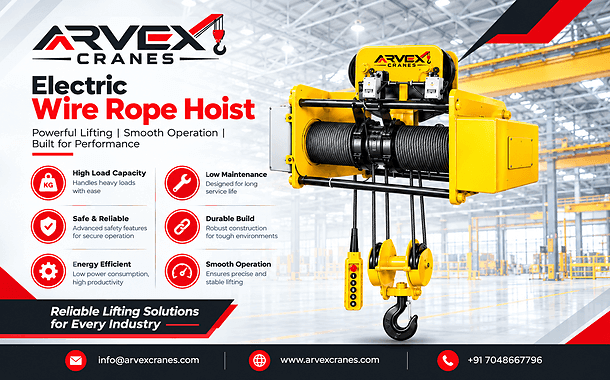
Electric Chain Pulley Blocks help your team lift heavy loads at the push of a button. They cut manual effort, speed up every lift, and keep workers safer than hand-pulled chain blocks. If your shop still relies on manual hoists, this guide shows what to check before you upgrade.
You will learn how an electric chain hoist works, which types exist, where each one fits, and how to pick the right capacity.
What Are Electric Chain Pulley Blocks?
An electric chain pulley block is a compact lifting machine. A motor drives a gearbox, the gearbox turns a load sprocket, and the sprocket pulls a hardened steel chain to raise or lower a hook.
People also call the same machine an electric chain hoist, an electric chain block, or a motorised chain pulley block. The names differ, but the job stays the same: lifting loads safely with minimal effort.
The operator never pulls a chain by hand. A pendant controls lifting, lowering and, on trolley models, side travel.
How Does an Electric Chain Pulley Block Work?
Follow this simple sequence:
- Press the pendant button. The motor starts and the brake releases.
- The gearbox takes over. It reduces motor speed and raises lifting torque.
- The load sprocket moves the chain. The chain lifts the hook block smoothly.
- Limit switches protect the hoist. They stop travel at the highest and lowest points.
- Release the button. The brake engages instantly and holds the load.
The slack chain drops into a chain container, so it stays tidy and safe.
Main Parts of an Electric Chain Hoist
- Motor: powers every lift.
- Brake: holds the load when the motor stops.
- Load chain: alloy steel chain built for high strength.
- Chain container: stores the loose chain.
- Limit switches and overload protection: prevent over-travel and overloading.
- Hook with safety latch: keeps the load attached.
- Pendant station: gives simple push-button control.
Common Types of Chain Pulley Blocks
A motorised chain pulley block comes in a few common designs.
Fixed Hook Hoists
These hang from a beam, hook or lifting point. They suit fixed workstations, assembly tables and machine loading.
Chain Block With Trolley
A chain block with trolley rides along an I-beam monorail. The operator lifts the load and moves it sideways along the beam. This setup suits production lines and workshop bays.
Single-Speed and Dual-Speed Models
Single-speed hoists handle general lifting. Dual-speed models add a slow speed, which helps when you place delicate or valuable parts with precision.
Key Benefits of Electric Chain Pulley Blocks
- Faster lifting: motor power cuts cycle time compared with manual pulling.
- Less strain: operators stay at a safe distance and avoid fatigue.
- Precise control: push-button operation allows smooth, accurate positioning.
- Compact design: short headroom fits low-ceiling shops.
- Low maintenance: few moving parts need simple, regular checks.
- Better value: higher output and fewer injuries lower your cost per lift.
Electric Chain Block vs Manual Chain Block vs Wire Rope Hoist
| Feature | Manual Chain Block | Electric Chain Block | Electric Wire Rope Hoist |
|---|---|---|---|
| Operation | Hand-pulled chain | Push-button motor | Push-button motor |
| Speed | Slow | Fast | Fast |
| Operator effort | High | Very low | Very low |
| Best for | Occasional light lifts | Frequent light-to-medium lifts | Heavy, high-duty lifts |
| Typical cost | Lowest | Medium | Higher |
Choose a manual block for rare, light jobs. Choose an electric chain block for regular lifting. Move to an electric wire rope hoist when loads are heavy or the duty cycle is high.
Where Are Electric Chain Pulley Blocks Used?
Industries use them wherever repeated lifting slows work down:
- Steel and fabrication shops: moving plates, pipes and structural parts.
- Automobile plants: loading engines, dies and assemblies.
- Warehouses: handling heavy cartons and pallets.
- Power plants: maintaining motors, pumps and valves.
- Workshops and maintenance bays: servicing heavy machines.
How to Choose the Right Electric Chain Pulley Block
Check these six points before you buy:
- Capacity: pick a safe working load above your heaviest load, and never exceed it.
- Lift height: measure the hook travel you need, not just the room height.
- Duty class: count lifts per hour. Heavy use needs a higher duty rating.
- Power supply: most Indian plants use 415 V, three-phase, 50 Hz supply. Confirm yours.
- Mounting: pick a fixed hook, or a chain block with trolley for beam travel. Check the beam flange width.
- Environment: dust, heat, moisture or outdoor use may need a higher protection rating.
Want to move loads across a full bay? Mount the hoist on a single girder EOT crane or a double girder EOT crane.
Safety and Maintenance Tips
- Never exceed the rated load.
- Never stand under a suspended load.
- Inspect the chain daily for stretch, twists, nicks and rust.
- Test the brake and limit switches before each shift.
- Lubricate the chain as the manual advises.
- Allow only trained, authorised operators.
- Arrange periodic examination and load testing as Indian factory rules require.
For wider guidance, read OSHA’s overhead and gantry crane safety page and the hoist overview on Wikipedia. You can also explore our Goliath crane guide and Jib crane range for other lifting solutions.
Why Choose Arvex Cranes for Electric Chain Pulley Blocks?
Arvex Cranes is a trusted electric chain hoist manufacturer in Ahmedabad. We design and build lifting equipment in-house, then test it before it leaves our plant.
- 10+ years of experience and 243+ completed projects
- 543+ happy customers across steel, fabrication, automobile, warehouse and power industries
- Load tested before dispatch for safe, stable performance
- Pan-India delivery with safe packaging
- Installation, commissioning, operator training and after-sales service
- GA drawings and manuals in English and Hindi
Need a chain block with trolley for your plant? Our engineers will help you match capacity, lift height and span.
Call: +91 7048667796 | Email: info@arvexcranes.com
Address: D/90, Phase-2, Swarnim Industrial Park, Bakrol-Dhamatvan Road, Bakrol, Ahmedabad 382430
Frequently Asked Questions
Q. What is an electric chain pulley block?
- An electric chain pulley block is a motor-driven lifting machine. It uses a steel load chain and a hook to raise and lower heavy loads. A pendant push button controls it, so the operator lifts without pulling any chain by hand.
Q. How does an electric chain pulley block work?
- A motor drives a gearbox and a load sprocket. The sprocket moves the chain and lifts the hook. When the operator releases the button, the brake holds the load, and limit switches stop travel at the top and bottom.
Q. How is an electric hoist different from a manual chain block?
- A manual chain block needs hand pulling, so it is slower and more tiring. An electric hoist uses a motor and push-button control. It lifts faster, needs less effort, and places loads more accurately.
Q What capacity range do chain hoists offer?
- Capacities commonly start around 250 kg and go up to several tonnes. The right size depends on your heaviest load, lift height and duty class. Share your requirement with Arvex Cranes, and our team will recommend a suitable model.
Q. Is a motorised chain pulley block the same as an electric hoist?
- Yes. “Motorised,” “motorized” and “electric” all describe a chain hoist driven by a motor and controlled from a pendant. The terms vary by region, but the machine and its working principle are the same.
Q. How often should I inspect it?
- Check the hook, chain, brake and limit switches before every shift. Schedule a thorough examination and load test at regular intervals, as Indian factory rules and the manufacturer’s manual require. Replace worn chains and damaged hooks immediately.
Q. Can I fit a chain hoist on an EOT crane?
- Yes. A trolley-mounted hoist can run on a single or double girder EOT crane. This lets you lift loads and move them across the full length and width of your bay.
Q. How much does one cost?
- Price depends on capacity, lift height, speed, trolley type and duty class. Higher capacity costs more. Contact Arvex Cranes with your load and lift details to get an accurate quote.
Conclusion
Electric Chain Pulley Blocks give you faster, safer and more accurate lifting in a compact package. Match the capacity, lift height, duty class and mounting to your job, and follow a strict inspection routine.
Ready to upgrade? Explore our electric chain pulley block range or contact the Arvex team for a free quote today.