
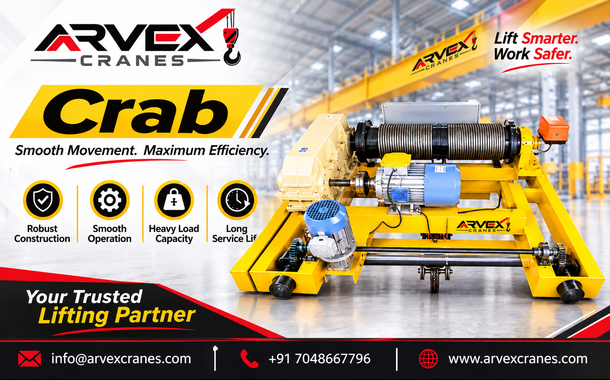
A reliable crab crane manufacturer builds the part of the crane that actually lifts and moves your load. The crab is the trolley that runs along the bridge girder of an EOT crane. It carries the hoist, motor, gearbox and drum. When the crane crab stops, your whole bay stops.
This guide explains how a crane crab works, which types are available and what to check before you buy. Use it to compare suppliers with confidence.
What Is a Crane Crab?
A crane crab is the movable trolley mounted on the girder of an overhead crane. It holds the hoisting mechanism and travels across the span. The bridge moves along the bay, and the crab moves across the bridge. Together, they let the hook reach any point in the work area.
People also call it a crab unit, crab trolley or winch trolley. Whatever the name, it does the real lifting work.
How Does a Crab in Crane Systems Work?
The crab in crane systems performs two movements: vertical lifting and cross travel. Here is the sequence:
- The operator presses a button on the pendant or remote.
- The control panel starts the hoist motor.
- The gearbox turns the rope drum, and the wire rope lifts the load.
- The brake holds the load when the operator releases the button.
- The cross-travel motor drives the wheels along the girder rails.
- Limit switches and the overload limiter stop unsafe movement.
Smooth acceleration and controlled braking reduce load swing. They also reduce wear on wheels, rails and gears.
Main Parts of a Crane Crab
- Hoist motor and gearbox: deliver lifting torque at a controlled speed.
- Rope drum and wire rope: wind in and carry the load.
- Brakes: hold the load and stop motion smoothly.
- Crab frame: a fabricated steel structure that carries every component.
- Wheels and cross-travel drive: move the crab along the girder.
- Safety devices: limit switches, overload limiter and emergency stop.
- Hook block: connects the load to the rope.
Types of EOT Crane Crab
Open Winch Crab
This crab runs on rails over a double girder bridge. It suits heavy loads and demanding duty cycles. Pair it with a double girder EOT crane for steel plants and heavy fabrication.
Hoist with Trolley
This type uses an electric wire rope hoist or chain hoist with a built-in trolley. It runs on the lower flange of a single girder. It saves headroom and cost. Pair it with a single girder EOT crane for workshops and warehouses. You can also explore our electric wire rope hoist range.
Custom Crane Crab
Some plants need special spans, tight headroom or unusual speeds. A custom EOT crane crab solves these cases. It can also serve Goliath cranes and gantry layouts.
Where Industries Use Crane Crabs
A crane crab appears in almost every plant that lifts heavy material:
- Steel and metal processing
- Fabrication shops
- Automobile and auto-component units
- Warehouses and logistics yards
- Power plants and substations
Each industry needs a different capacity, duty class and speed. That is why customisation matters.
How to Choose a Crab Crane Manufacturer
Compare suppliers on these points before you place an order:
| Check | What to look for |
|---|---|
| Capacity and duty class | Match the crab to your heaviest load and daily lifting cycles |
| Span and lift height | Confirm the crab fits your bay and hook height |
| Speeds and control | Ask for variable speed for smooth, precise positioning |
| Safety features | Look for overload protection, limit switches and brakes |
| Build quality | Prefer in-house fabrication and a load test before dispatch |
| After-sales support | Confirm installation, training, spares and service |
Also check compatibility. The crab, end carriage and electric panel must work as one system. Ask for general arrangement drawings and manuals before approval. For safety norms, read the guidance from the Bureau of Indian Standards and the Crane Manufacturers Association of America.
Crane Crab Maintenance Tips
Regular care extends the life of your crab and prevents unplanned downtime.
- Inspect wire rope for broken strands, kinks and wear.
- Test brakes before every shift.
- Check gearbox oil level and lubricate on schedule.
- Verify limit switches and the overload limiter.
- Inspect wheels and rails for wear and misalignment.
- Keep inspection records and train every operator.
Why Choose Arvex Cranes as Your Crab Crane Manufacturer
Arvex Cranes is an engineering company based in Ahmedabad, Gujarat. We design and build EOT cranes, Goliath cranes, Jib cranes, electric chain pulley blocks and electric wire rope hoists. Our crab units are built for smooth movement and heavy-load handling.
Here is what sets us apart:
- 10+ years of experience and 243+ completed projects.
- 543+ happy customers across India.
- In-house manufacturing: we build the girder, end carriage, trolley, hoist, control panel and pendant ourselves.
- Load tested before dispatch for safe and stable performance.
- Installation and training: our team handles site installation, commissioning and operator training.
- Clear documentation: GA drawings plus operation and maintenance manuals in English and Hindi.
- Pan-India delivery to all major industrial cities.
Contact Arvex Cranes
- Address: D/90, Phase-2, Swarnim Industrial Park, Bakrol-Dhamatvan Road, Near Kashtbhanjan Weigh Bridge, Bakrol, Ahmedabad – 382430
- Phone: +91 7048667796
- Email: info@arvexcranes.com
- Website: www.arvexcranes.com
Frequently Asked Questions
Q.What is a crane crab?
- A crane crab is the trolley unit that travels along the girder of an overhead crane. It carries the hoist, motor, gearbox and drum. It lifts the load and moves it across the span.
Q.What is the role of a crab in crane systems?
- The crab in crane systems lifts loads vertically and moves them sideways along the girder. Combined with bridge travel, it positions the hook anywhere in the bay. It also houses key safety devices.
Q.What is the difference between a crab and a hoist?
- A hoist is the lifting machine. A crab is the trolley that carries the hoist and moves it along the girder. An open winch crab includes the hoisting parts. A hoist with trolley combines both in one unit.
Q.Who is a trusted crab crane manufacturer in Ahmedabad?
- Arvex Cranes is an Ahmedabad-based crab crane manufacturer with 10+ years of experience and 243+ completed projects. We build crab units in-house, load test them before dispatch and support installation across India.
Q.Can I customise an EOT crane crab?
- Yes. Arvex Cranes customises the EOT crane crab for capacity, span, duty class, speed and plant layout. Share your load, span and lift height, and our engineers will recommend the right design.
Q.How often should I inspect a crane crab?
- Check brakes, limit switches and hooks before every shift. Inspect wire rope, gearbox oil and wheels weekly or monthly. Schedule a full inspection each year, as per your duty class and local safety rules.
Q.Does Arvex Cranes deliver across India?
- Yes. We dispatch by road to all major industrial cities. Each crab is packed securely, supplied with drawings and manuals, and supported with installation and after-sales service.
Conclusion
The crab is the working heart of an overhead crane. The right design improves safety, speeds up production and cuts maintenance cost. When you evaluate a crab crane manufacturer, check build quality, load testing, customisation and after-sales support.
Arvex Cranes offers all four. Call +91 7048667796 or email info@arvexcranes.com to request a free quote.